
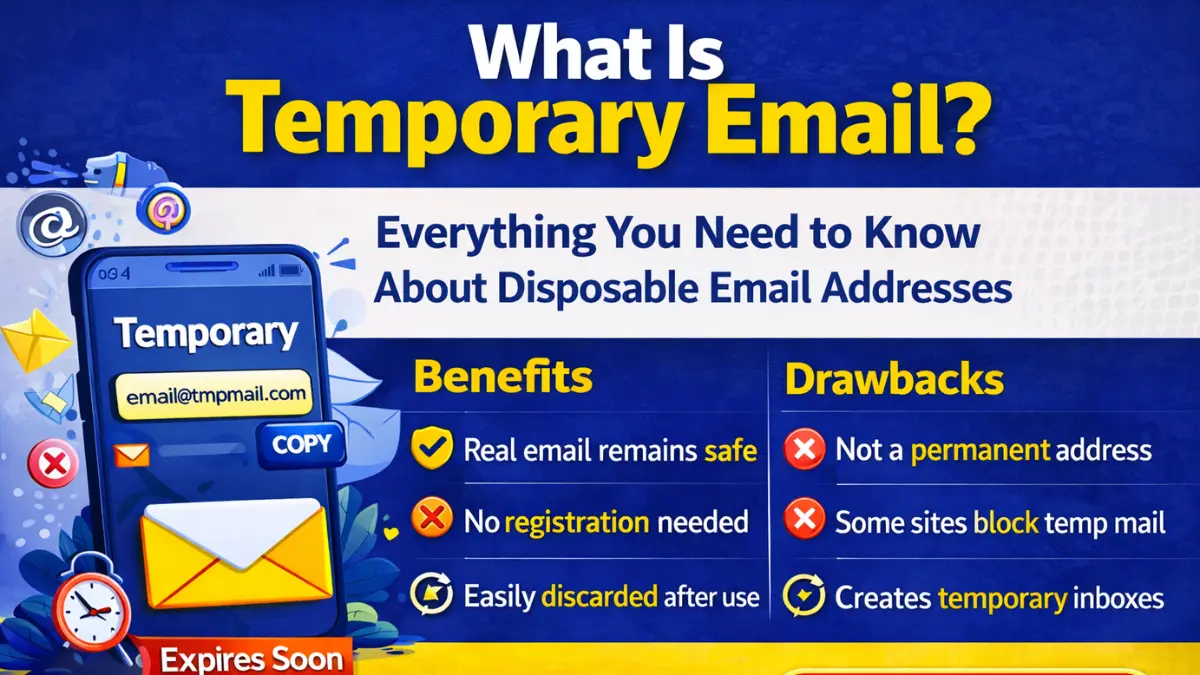
Every time you sign up for a new website, you hand over your real email address. And within days — sometimes hours — you’re drowning in newsletters you never asked for, promotional blasts that won’t stop, and spam that somehow found its way past your filters.
There’s a smarter way to handle this. It’s called a temporary email address, and once you start using one, you’ll wonder how you ever managed without it.
This guide covers everything — what temp mail actually is, how it works under the hood, whether it’s genuinely safe, and the real-world situations where it saves your inbox (and your sanity).
What Is Temporary Email?
A temporary email is a disposable, short-lived email address that you can create in seconds — no registration, no password, no personal information required. You use it to receive emails, complete signups, or verify accounts, and then you simply let it expire or delete it when you’re done.
Unlike your regular Gmail or Outlook address that you’ve had for years and plan to keep forever, a temporary email exists for a single purpose. Once that purpose is served, the address vanishes along with everything in it.
You might see it called by other names — disposable email, throwaway email, temp mail, fake email, or burner email. They all refer to the same concept: a real, functioning email address that’s intentionally temporary.
The key thing that makes it different from your personal inbox? There’s zero attachment. No history, no identity, no consequences when it disappears.
How Does Temp Mail Work?
The mechanics behind temporary email are actually quite straightforward, though clever in their execution.
Step 1 — Address Generation
When you visit a temp mail service, it automatically generates a random email address for you. Something like r8x2p@mailtemp.net or bluefox49@trashmail.io. This address is live immediately — no setup required. Some services let you customize the username or choose from multiple domains, while others keep it fully random.
Step 2 — A Dedicated Inbox Is Created
The moment that address is generated, the service creates a temporary inbox tied to it on their server. This inbox starts empty and has a built-in lifespan — usually anywhere from 10 minutes to 24 hours, depending on the platform. Some services extend or reset this timer every time a new message arrives.
Step 3 — Emails Are Received in Real Time
You take your temp email address, paste it into whatever form or signup page you’re on, and complete the process. When the confirmation email, OTP, or verification link hits that inbox, it appears in your temp mail interface almost instantly. You click the link, confirm whatever needs confirming, and you’re done.
Step 4 — The Address Expires
After the set time period — or immediately when you choose to delete it — the address and everything in it disappears permanently. No archive, no recovery, no trace.
That’s the entire cycle. Fast, clean, and completely anonymous.
What’s Actually Happening on the Technical Side?
Temp mail providers run their own mail servers with a pool of registered domains. When you generate an address, the server starts listening for incoming messages addressed to that specific inbox. Most modern services use WebSocket connections or automatic polling to update your inbox view in real time, so you see new emails appear without manually refreshing the page.
Is Temporary Email Safe?
This is the question most people ask, and it deserves an honest, nuanced answer — not a blanket yes or no.
Where Temp Mail Is Genuinely Safe
For its intended use cases, temporary email is safe and entirely legal. Using it to protect your personal inbox from spam, test a signup flow, or avoid handing your real address to websites you don’t fully trust is a completely reasonable and responsible thing to do.
The service itself doesn’t collect your real identity. You never log in, so there’s no account to breach. When the inbox expires, the data is gone — there’s nothing stored long-term that could be leaked or sold.
Where You Should Be Cautious
Don’t use temp mail for anything important. Because the address expires and you often can’t recreate the exact same address later, using it for banking, government services, or accounts you genuinely need long-term is a bad idea. You could lose access to those accounts permanently.
Your inbox is technically public while it’s active. Most temp mail services don’t encrypt inboxes or require authentication. Anyone who knows — or guesses — your temporary address can view those emails. This is fine for low-stakes confirmations, but never use a temp address to receive sensitive documents, passwords, or private information.
Some services store messages briefly on their servers. Read the privacy policy of whatever temp mail tool you’re using. Reputable services are clear about their data retention policies.
The Bottom Line on Safety
Temp mail is a privacy tool, not a security tool. It keeps your real email address private and your inbox clean. It doesn’t encrypt your communications or make you anonymous in any deep technical sense. Use it for what it’s good at, and don’t use it as a substitute for proper security practices.
Temp Mail vs Regular Email — What’s the Difference?
Most people use both, just for very different things. Here’s how they compare across the factors that actually matter.
| Feature | Temporary Email | Regular Email |
|---|---|---|
| Setup Time | Instant — no registration | Minutes to create |
| Personal Info Required | None | Name, phone, recovery info |
| Lifespan | Minutes to 24 hours (some longer) | Permanent |
| Storage | None to minimal | GBs of storage |
| Password Protected | No | Yes |
| Accessible Later | No (expires) | Yes, from any device |
| Spam Risk to Inbox | Zero | High over time |
| Attachments | Usually viewable | Full support |
| Sending Emails | Most services — no | Yes |
| Best For | One-time signups, verification | Ongoing communication |
The distinction is really about permanence vs. purpose. Your regular email is an identity — it follows you, stores your history, connects to your accounts. A temporary email is a tool — you pick it up, do the job, put it down.
Benefits of Disposable Email
The advantages of using temporary email go beyond just keeping spam out of your inbox. Here’s a fuller picture of why people reach for it.
1. Your Real Inbox Stays Clean
This is the obvious one. When you use a temp address for a one-time signup, that site’s marketing emails go nowhere near your actual inbox. Your personal and work emails stay focused, uncluttered, and easier to manage.
2. Your Privacy Is Protected
You’re not handing over a permanent address — which, once shared, can be sold to data brokers, included in leaked databases, or used to build profiles about you. A temp address that expires leaves no trail back to your real identity.
3. No More Unwanted Subscriptions
Signed up for a discount code? Downloaded a free guide that required your email? Used a temp address? When that site starts sending you three emails a week, they’re sending them to an inbox that no longer exists. Problem solved, permanently.
4. Faster Testing for Developers
If you’re building or testing apps that send verification emails, temporary email addresses are a development essential. You can test the full signup flow repeatedly without polluting real inboxes or needing to manage test accounts.
5. Exploring New Services Without Commitment
Curious about a new platform but not sure if you’ll stick around? A temp address lets you explore it without committing your real email. If the service turns out to be useful, you can always create a real account later.
6. Bypassing Paywalls and Registration Walls
Some sites require an email address just to read an article or access a single piece of content. A disposable address gets you through the gate without handing over anything you care about.
7. Reduction in Phishing Exposure
The fewer places your real email address exists online, the smaller your attack surface for phishing attempts. Temp mail keeps your primary address out of more databases.
Common Use Cases for Temporary Email
Understanding when people actually reach for temp mail helps illustrate how broadly useful it is.
Online Shopping Discounts — Many e-commerce sites offer first-purchase discounts if you subscribe to their newsletter. A temp address gets you the code without subscribing to years of promotional emails.
Free Trial Signups — Software companies often limit free trials to one per email address. Whether you want a second trial or just don’t want marketing emails forever, a disposable address solves both.
Public Wi-Fi Portals — Airports, hotels, and cafes frequently require an email address to connect to their Wi-Fi. A temp address satisfies the requirement without exposing your real contact details.
Forum and Community Registration — Signing up for a niche forum or community you’re not sure you’ll stay active in? Temp mail lets you participate without a long-term commitment.
App and Software Testing — Developers and QA testers use disposable addresses constantly to simulate fresh user experiences and test email-triggered workflows.
Avoiding Data Broker Sign-ups — Any site that asks for your email before showing you content is essentially collecting your address. Temp mail keeps those sites from accumulating your real data.
Research and Competitive Analysis — Marketers, researchers, and product teams often sign up for competitor services or industry tools during research phases. A temp address keeps their personal or professional inbox separate.
Event Registration — Conference registrations, webinar signups, and one-off event RSVPs often lead to ongoing email from organizers and sponsors. A disposable address handles the registration without the aftermath.
FAQs About Temporary Email
Can I send emails from a temporary address?
Most temp mail services are receive-only — they’re designed to accept incoming messages, not send them. A handful of more advanced services do allow sending, but this is the exception rather than the rule. If you need to send emails anonymously, that’s a different tool category entirely.
How long does a temporary email address last?
It depends on the service. The most common range is 10 minutes to 1 hour by default, with many platforms extending the timer automatically when new messages arrive. Some services offer 24-hour or even 7-day addresses. Check the specific service you’re using for its expiry policy.
Can websites detect that I’m using a temp mail address?
Yes, increasingly so. Many websites and apps now use email validation APIs that flag known disposable email domains and block signups from them. Popular temp mail domains get blacklisted over time. Some services rotate their domains regularly to stay ahead of these blocklists — it’s an ongoing cat-and-mouse dynamic.
Is using a temporary email address legal?
In most countries, yes — using a disposable email address is entirely legal. It’s simply a privacy choice. That said, some websites’ terms of service prohibit the use of disposable emails. Using one to bypass those terms may violate the site’s policies, even if it’s not illegal in a broader legal sense.
What happens to my emails when the temp address expires?
They’re deleted. Permanently. There’s no archive, no recovery option, no way to retrieve them after expiry. This is by design — it’s what makes the service genuinely disposable. Never use a temp address if there’s any chance you’ll need to access those emails later.
Can someone else use the same temporary address as me?
On most services, the address is generated randomly and is unique while it’s active. However, once an address expires and is released back into the pool, another user could theoretically be assigned the same address later. This is one reason you should never use temp mail for sensitive information — the inbox isn’t truly private.
Are there any downsides to using disposable email?
Yes, a few. You can’t use them for accounts you need long-term access to. Some services actively block temp mail domains. You can’t send replies or initiate conversations. And if you lose track of which service you signed up for using which temp address, account recovery becomes impossible. For short-term, low-stakes use, none of these are deal-breakers — but they’re worth knowing.
Which temporary email service should I use?
There are dozens of options, ranging from dead-simple single-page tools to more feature-rich platforms. Look for services that are transparent about their data handling, don’t require any personal information, and ideally have been around long enough to have a track record. As with most free tools, read the privacy policy before trusting it with anything remotely sensitive.
Temporary email is one of those small tools that, once you start using it, quietly makes a noticeable difference in your digital life. Less noise in your inbox. Less of your data floating around in databases you’ve forgotten about. A little more control over who gets to reach you — and when.