Think about how many times a week something asks you for your email address.
That checkout form. The free download. The webinar registration. The store loyalty card. The app you’ll probably use once and forget about. Each one feels harmless on its own, but add them all up over months and years and you’ve handed your email address to hundreds — possibly thousands — of places you barely remember.
Your email address is your digital passport. It’s the one piece of contact information that almost every online service requires, and once you share it, you lose control of where it goes next. Databases get hacked. Companies sell lists. Marketing teams get aggressive. Somewhere along the way, your inbox starts looking more like a junk drawer than a communication tool.
Disposable email addresses are the practical solution most people have never thought to try. Here’s the full picture — how they work, why you genuinely need one, and how to use them effectively.
What Is a Disposable Email Address?
A disposable email address (DEA) is a real, functioning email address that you create temporarily, use for a specific purpose, and then discard — either manually or by letting it expire on its own.
It works just like any other email address as far as websites and services are concerned. It passes email validation. It receives messages. It handles confirmation links and one-time passwords. The key difference is that it’s completely disconnected from your actual identity.
If that address ends up on a spam list, gets leaked in a breach, or starts receiving unwanted mail — you simply cancel it or let it disappear. Your real email address never gets touched. Your main inbox stays clean.
You’ll hear it called different names depending on who’s talking about it: throwaway email, fake email, temp mail, burner email, or one-time email address. Same idea, different labels.
Why Your Real Email Address Is More Vulnerable Than You Think
Most people don’t realize how exposed their email address actually is until it’s too late.
Retail loyalty programs, giveaway entries, forum registrations, software trials, newsletter signups — each of these represents a company holding your email address in a database somewhere. And companies get hacked constantly. Even well-known brands with substantial security budgets have suffered breaches that exposed millions of customer email addresses to the open web.
Once your address shows up in a leaked database, it circulates. Spam lists are traded and sold. Phishing campaigns get more targeted. The quality of junk in your inbox gets worse over time, not better.
There’s also the simpler problem of legitimate-but-relentless marketing. Sign up for one store’s offers and you might hear from them three times a week indefinitely. A disposable address absorbs all of that without it ever reaching you.
How Disposable Email Actually Works Under the Hood
The mechanics are cleaner than most people expect.
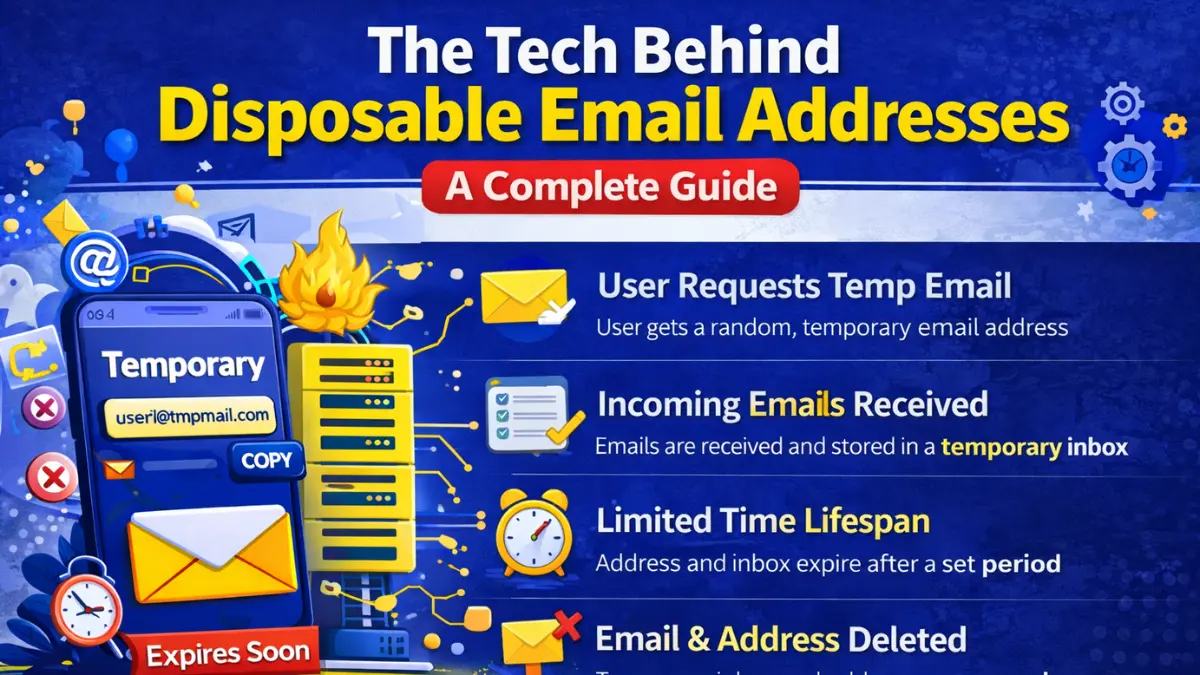
Disposable email providers run their own mail servers with registered domains. When you visit a temp mail service and an address gets generated — something like k9w3r@quickdrop.net — that address becomes live on the server immediately. No account creation, no database entry, no personal information collected.
The server begins listening for any incoming mail addressed to that specific inbox. When an email arrives, it gets pushed to your browser in real time using WebSocket connections — the same technology that makes live chat and real-time notifications work. You don’t need to refresh the page. The message just appears.
Each inbox has a built-in expiry window. Most services default to somewhere between 10 minutes and an hour. Some automatically extend this timer when new messages arrive. When the window closes, the inbox and everything in it is deleted permanently — no archive, no recovery, no trace.
More advanced disposable email setups also support forwarding. You can configure a temporary address to route incoming messages directly to your real inbox. This keeps your actual address private while still getting everything delivered where you need it. And if that forwarding address ever becomes compromised or starts attracting spam, cutting it off is instant — no effect on your real account whatsoever.
Real Reasons People Actually Use Disposable Email
The concept sometimes gets unfairly associated with sketchy behavior. But the practical, everyday use cases are completely legitimate.
Loyalty Cards and Retail Sign-Ups
Most stores require an email address to activate a loyalty account or apply a discount code. Use a disposable address and you get the perk without inheriting a lifetime of promotional emails. And if that retailer’s database ever gets breached, your real address isn’t in it.
Extending Free Trials
Streaming services, software tools, and subscription platforms typically limit free trials to one per email address. Linking a disposable address that forwards back to your real inbox lets you evaluate a service longer before committing. People do this constantly — it works.
Testing Your Own App or Website
If you’re a developer building something with user accounts and email-triggered workflows, disposable addresses are invaluable. You can spin up dozens of fresh inboxes in minutes to test signup flows, onboarding sequences, password resets, and confirmation emails without managing separate real accounts or cluttering up actual inboxes.
Running Multiple Accounts
Some platforms allow one account per email address. When you genuinely need a second account — a separate social media profile for a project, a different automation account for a second workflow — a disposable address makes it straightforward to create one without maintaining an entirely new email inbox.
Forum and Community Sign-Ups
Joining an online community you’re not sure you’ll stay active in? There’s no reason to hand over your real email address to a platform you’re still evaluating. Use a disposable one, and if the community turns out to be worth sticking around for, you can always update your details later.
Cutting Out Spam Entirely
For anyone who regularly fills out web forms, enters contests, participates in discussion boards, or downloads gated content — the cumulative spam problem is real. A disposable address used consistently for these lower-stakes interactions dramatically reduces the noise hitting your actual inbox.
How to Pick a Good Disposable Email Service
The best services share a few common qualities that are worth knowing before you choose one.
No registration, ever. The moment a temp mail provider asks you to create an account, they’ve undermined the core purpose. A good service generates your address instantly with zero personal information required.
Instant generation. One click. One address. Live immediately. No steps in between.
Real-time inbox updates. You shouldn’t be sitting there hitting refresh waiting for a confirmation email to show up. Look for services that push emails to your browser automatically — they’re noticeably faster and more pleasant to use.
Multiple addresses on demand. Needing ten different disposable addresses for ten different signups shouldn’t require any extra work. Good services let you generate as many as you need in seconds.
Multiple domain options. Some websites actively blocklist known disposable email domains and won’t accept addresses from them. A service with several domain choices gives you more flexibility when this happens.
Clean, simple interface. This is a utility tool, not a feature-heavy platform. The best ones are fast, obvious, and get out of your way.
Clear privacy policy. Understand what happens to your data during the time your inbox is active. Reputable services are straightforward about this.
Using Disposable Email Correctly — And Where Not To
Getting the most out of temp mail means understanding its limits as clearly as its benefits.
For one-time verifications, trial signups, retail registrations, and anything where you want no ongoing relationship with the sender — disposable email is ideal.
For accounts you actually need long-term access to, it’s the wrong tool. Banks, government portals, work accounts, anything where you might need to log back in or recover access later — always use your real address. Temporary inboxes expire and can’t be recovered, which means a critical account with a dead temp address attached is effectively locked forever.
Similarly, since most temp mail inboxes aren’t password-protected, don’t route anything sensitive through them while they’re active. Anyone who knows or guesses your temporary address can read what’s in it. For routine confirmations and verification links, this is a non-issue. For private correspondence or sensitive documents, it’s a genuine concern.
The Practical Takeaway
A disposable email address doesn’t require a technical background to use or a complicated setup to benefit from. It’s a simple, fast privacy tool that solves a problem most email users live with unnecessarily.
Your real email address is worth protecting. It carries your identity, your accounts, your communication history. The more selectively you share it, the less junk you’ll deal with, the smaller your exposure in data breaches, and the cleaner your actual inbox stays.
Use your real address for the things that matter. Use disposable addresses for everything else. The habit takes about ten seconds to build and pays off every single day.
Frequently Asked Questions
What makes a disposable email address different from a regular email account?
A regular email account is permanent, requires registration, and needs ongoing management. A disposable address is generated instantly with no personal information, has a built-in expiry, and deletes itself automatically. For one-time signups and quick verifications, there’s no comparison — temp mail is faster, cleaner, and leaves nothing behind.
Can websites block disposable email addresses?
Yes. Many platforms now use validation services that flag known disposable email domains. A good temp mail provider works around this by offering multiple domains and rotating them regularly — but it’s worth knowing this limitation exists if you run into a site that rejects your temporary address.
Is it legal to use a disposable email address?
In most countries, yes — completely legal. It’s a personal privacy decision. That said, some services explicitly prohibit disposable emails in their terms of service, so using one on those platforms may technically violate their policies even if it’s not illegal.
Will forwarding work if my temporary inbox expires?
Forwarding is only active while the inbox exists. Once the address expires, any forwarding configured for it stops. If you need forwarding over a longer period, look for services that offer extended or manually-controlled expiry rather than automatic short windows.
Can I reply to emails from a disposable address?
Most disposable email services are receive-only — built purely for incoming messages. Some providers offer limited sending capability, but this isn’t universal. If two-way communication matters for your use case, check your specific provider’s features before relying on it.