
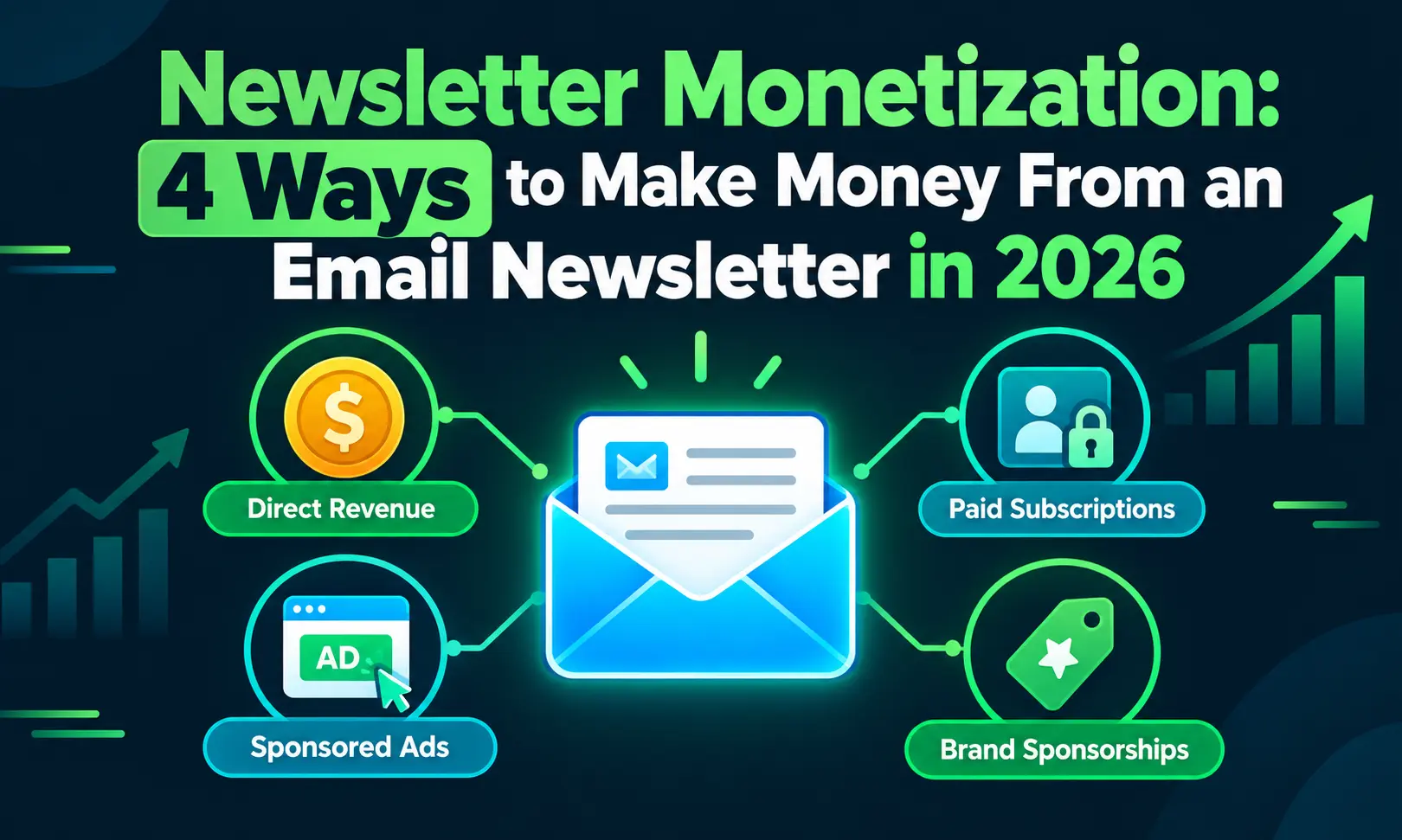
Newsletter monetization guides published throughout 2026 describe a shift away from relying on a single income stream, with publishers instead combining sponsorships, paid subscriptions, affiliate revenue, and digital products across the same email list. Analysts covering the space frame monetization as a matching problem, where the right model depends on the size, engagement, and topic of a given newsletter rather than a one-size-fits-all approach.
Guides consistently identify four models as carrying the highest return in 2026: sponsorships, paid subscriptions, affiliate marketing, and digital products, with publishers able to begin monetizing with as few as 1,000 engaged subscribers if their niche commands premium advertiser rates.
Sponsorships Reward Reach And Engagement
Sponsorship deals remain one of the fastest ways for a newsletter to generate revenue once it has an established audience. Guides recommend building a one-page media kit listing list size, open rate, click rate, audience demographics, and representative content topics before approaching brands.
Platforms including Paved, SparkLoop, and Letterhead are cited as tools that connect publishers to sponsors once a list reaches sufficient size, while warm outreach to brands whose products an audience already uses is described as converting far better than cold pitching. One 2026 playbook recommends keeping open rates above 40 percent before pursuing premium sponsorship pricing, and describes a dedicated send, where an entire email is written around a single sponsor, as commanding three to five times the rate of a standard placement.
Paid Subscriptions Turn Engaged Readers Into Recurring Revenue
The most effective subscription structure pairs a free tier that delivers real value with a paid tier offering deeper analysis, archived access, early content, or direct reader access to the author. Platforms such as Substack, Ghost, and Beehiiv are cited as natively supporting this dual-tier model.
Guides note that list quality matters more than raw size for this model, pointing out that a 1,000-subscriber list with open rates above 40 percent is more monetizable than a 10,000-subscriber list with only 5 percent engagement.
Affiliate Revenue As The Fastest Starting Point
Affiliate marketing is repeatedly described as the quickest path from zero to first-dollar revenue, since it requires no upfront relationship-building with brands and pays out immediately on conversion. Publishers already writing about tools, products, or services in their niche are described as commonly leaving commissions uncaptured simply by not adding affiliate links to existing recommendations.
Guides stress that transparency is central to sustaining this revenue stream, since disclosing affiliate relationships keeps trust intact, while readers who feel misled tend to unsubscribe rather than continue clicking.
Digital Products And Courses Extend The Model Further
Newsletters that have established the author as a subject-matter expert increasingly branch into pre-recorded courses, live workshops, and cohort-based programs. Guides recommend validating demand before building a course, suggesting a survey or a pre-sale offer, so that a threshold of deposits, such as 50 paying readers, both confirms interest and funds development at the same time.
Higher-ticket product launches are cited as producing outsized single-event returns. One example describes a 97-dollar digital course sold to a newsletter audience at a 3 percent conversion rate generating close to 5,820 dollars from 2,000 subscribers in a single launch, a figure guides describe as often exceeding a full year of affiliate income from the same list.
What The Onboarding Sequence Is Worth
Data compiled this year shows welcome emails reaching open rates as high as 83.63 percent, with welcome sequences producing up to four times higher opens and five times higher clicks than a standard newsletter send. Guides frame this as evidence that a weak onboarding flow leaks subscriber value from the very first message, regardless of how strong later monetization efforts are.
Balancing Value Against Selling
Across nearly every guide reviewed, the same ratio recurs: roughly 80 percent of newsletter content should deliver pure, actionable value with no attached offer, while the remaining 20 percent can carry a direct pitch. A recurring soft-touch approach, such as a short postscript linking to a product or service at the bottom of every email, is recommended as a lower-friction alternative to frequent hard sells.
Current Status
As of September 2026, newsletter monetization guides continue to recommend stacking multiple revenue layers rather than depending on one model, with sponsorships and paid tiers cited as the most common starting points before publishers add digital products, affiliate links, or live events as their lists mature. Industry benchmarks published this year continue to tie revenue potential more closely to engagement rate and audience trust than to raw subscriber count.