
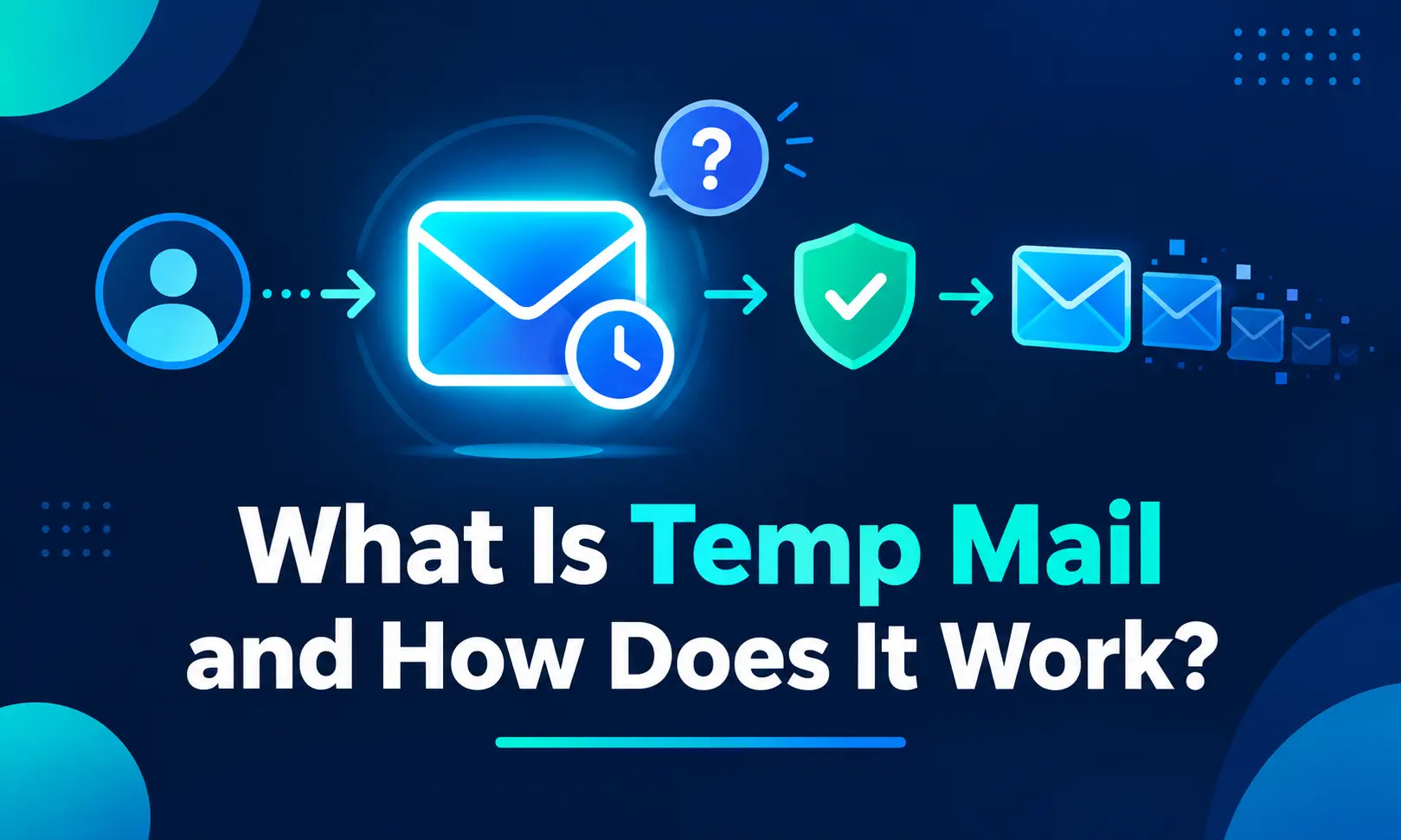
Temp mail is a free, receive-only email service that creates a working inbox instantly, without registration, and deletes it automatically after a set period. Providers across the industry describe the same basic function in 2026: a real address appears the moment a user opens the page, and it disappears once its retention window ends.
The term covers several interchangeable names, including disposable email, throwaway email, burner email, and 10-minute email, all referring to the same underlying concept of a short-lived inbox built for one-time use.
How An Inbox Gets Created
Temp mail services generate a unique email address the instant a visitor loads the page, with no account, password, or personal information required. Most services use WebSocket connections so incoming mail appears in the browser in real time, without needing to refresh the page.
Once generated, that address functions like any standard inbox for receiving purposes. It can accept verification codes, confirmation links, passwordless login prompts, one-time download links, receipts, and standard transactional messages.
Providers differ on whether a user can choose a custom username or must accept a randomly assigned one, and whether the service allows more than one address to be generated at a time.
Why Inboxes Self-Destruct
Every temp mail inbox is built around an expiration timer, ranging from as short as 10 minutes on some services to a few hours on others. Once that window closes, the address stops receiving new mail, and any messages already inside are permanently deleted.
There is no recovery option once an inbox expires, and no archive to search through afterward. Guides describe this as a self-destructing design meant to leave no lasting trace once the short-term task is finished.
How It Differs From Aliases And Plus Addressing
Temp mail is fully separate from a person’s real email identity, unlike two commonly confused alternatives. Email aliases, such as iCloud Hide My Email or Firefox Relay, forward incoming messages to a real inbox, meaning the real account still receives everything even though the visible address differs.
Plus addressing, written as a standard address with a plus sign and a label added before the domain, is even less private, since the added label does not hide the underlying account and can simply be removed by whoever receives it. Temp mail avoids both of these limitations by having no connection to a permanent inbox at all.
What It Is Built For
The stated purpose across provider guides is consistent: cutting off the promotional email sequences that follow nearly every signup, and containing the fallout if a smaller service later suffers a data breach. A disposable address absorbs both risks instead of a person’s daily inbox.
Guides frame the practice as routine internet hygiene rather than anything secretive, describing it as smarter control over which entities gain access to a real inbox rather than concealment or wrongdoing.
Some providers also tie the practice to data protection principles. Regulatory bodies including the European Union Agency for Cybersecurity and the U.S. Federal Trade Commission have emphasized data minimization, and disposable email guides cite that principle directly, noting that not sharing personal data in the first place leaves less information to secure or later have exposed.
Where Temp Mail Falls Short
Guides are consistent in warning against certain use cases. Temp mail is not suited for banking, healthcare portals, government services, or any account a person intends to keep and recover later, since password resets and security alerts route through the same address that will eventually expire.
Some services offer longer-lived tiers as a middle ground, including inboxes lasting up to 30 days for registered users or password-protected addresses that persist until manually deleted, positioned for slightly longer projects without committing to a permanent account.
Current Status
As of September 2026, temp mail services continue to expand around instant, no-signup inbox generation, with most retention windows still falling between 10 minutes and 24 hours depending on the provider. Industry guides continue to draw a consistent line between short-term disposable use and the long-term account recovery needs that only a permanent email address can support.